THND Staff | 3:14 PM, August 12, 2026
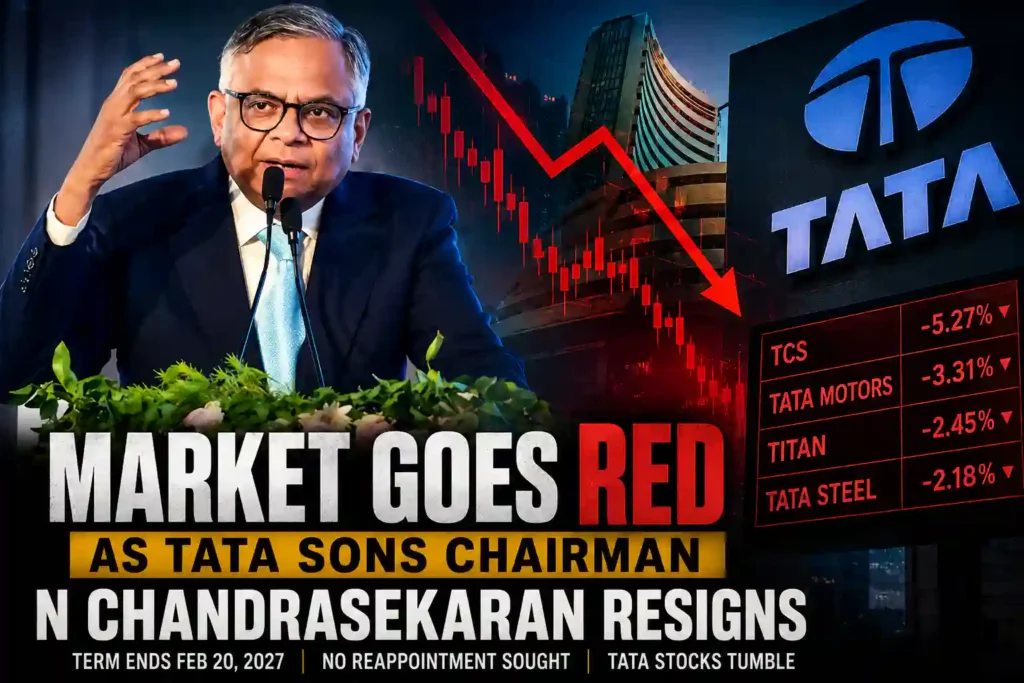
The Tata Sons Chairman resignation of N Chandrasekaran has sent shockwaves through Indian markets, with shares of several Tata Group companies falling sharply after he announced that he would not seek reappointment when his current term ends in February 2027.
Chandrasekaran communicated his decision to the Tata Sons Board on August 12, saying that his existing tenure will end on February 20, 2027. He said he had decided not to offer himself for another term after the board failed to reach a resolution on his proposed five-year extension.
The announcement triggered an immediate negative reaction across Tata Group-listed companies. Reuters reported that Tata Consultancy Services fell more than 5%, while Tata Motors declined around 3.3%. Titan and Tata Steel also moved lower during the sell-off.
The market reaction highlights how important leadership continuity at Tata Sons is to investors.
Why the Tata Sons Chairman resignation matters
Chandrasekaran has led Tata Sons for nearly a decade and has been associated with major strategic decisions across the conglomerate.
His current term was formally approved for five years from February 21, 2022, through February 20, 2027.
According to Chandrasekaran’s statement, the Sir Dorabji Tata Trust and Sir Ratan Tata Trust had unanimously recommended extending his tenure for another five years.
The recommendation was subsequently considered by the Tata Sons Nomination and Remuneration Committee and the board.
However, when the proposal was placed before the Tata Sons Board on February 24, 2026, it did not receive unanimous support.
Chandrasekaran said that because one board member did not support the proposal, he chose to defer the decision.
Six months later, he said, no resolution had been reached.
That prolonged uncertainty appears to have been an important factor behind his decision.
Tata Group stocks react to leadership uncertainty
The market response was immediate.
Reuters reported that the sell-off spread across several major Tata companies, with investors reacting to uncertainty over the group’s future leadership. TCS was among the biggest decliners, while Tata Motors, Titan and Tata Steel also fell.
The reaction does not necessarily mean investors believe the Tata Group’s businesses have fundamentally deteriorated.
Instead, analysts have described the initial move as a knee-jerk response to an unexpected leadership development. The longer-term market reaction is likely to depend heavily on who eventually succeeds Chandrasekaran and how smoothly the transition is handled.
For investors, the immediate question is therefore not simply why Chandrasekaran is leaving.
It is who comes next.
Succession now becomes Tata Sons’ biggest priority
Chandrasekaran himself emphasized the importance of succession planning in his statement.
He said Tata Sons is a very large institution with several strategic projects at critical stages and argued that clarity over leadership is important for employees, investors, partners and other stakeholders.
He has asked the board to decide on succession soon so that the group can ensure a proper transition.
That makes the next several months particularly important for Tata Sons.
The company now has time to identify and prepare a successor before Chandrasekaran’s current tenure expires on February 20, 2027.
What investors will watch next
The leadership transition comes at a sensitive period for the Tata Group.
Its major listed companies operate across technology, automobiles, steel, consumer products, hotels, power and other sectors. Decisions taken at the Tata Sons level can therefore influence investor sentiment far beyond the holding company itself.
TCS, Tata Motors, Titan and Tata Steel are among the companies whose shares immediately reflected the uncertainty.
The group has also been dealing with several strategic challenges. Tata Motors and Jaguar Land Rover face their own industry pressures, while TCS is navigating a difficult global technology environment.
Against that backdrop, investors will be watching whether the succession process is orderly and whether the next chairman can maintain continuity while addressing emerging challenges.
The Tata Sons Chairman resignation is therefore more than a change at the top of a holding company.
It represents the beginning of a potentially significant leadership transition for one of India’s most recognizable business groups.
For now, Chandrasekaran remains chairman during his existing term. His announcement means that the focus has shifted from whether he will receive a third term to who will lead Tata Sons after February 2027.
The market’s sharp reaction shows that investors want that answer sooner rather than later.
The next few months could therefore become one of the most closely watched succession processes in Indian corporate India.